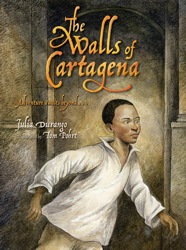
•   It is the 17th century in Cartagena of the Indies (modern day Columbia), a time and place in which the slave trade is alive and well.  Thirteen year old Calepino, orphaned by his mother who died on a slave ship, finds himself in comfortable circumstances.  The  noblewoman Dona Isabel has taken him in and shown an interest in his education.  Through his studies, Calepino shows an affinity for languages and soon is fluent in 11 of them, both African and European.   This talent serves him well when, on his 13 birthday, he is taken in by the local Catholic priest Father Pedro to work in the monastery.

    Father Pedro introduces Calepino to a cruel world that he only narrowly escaped.  They board crowded and stinking slave ships to care for the sick and dying.  They visit slave holding cells to administer last rights.  Through their work together, Calepino meets Mara and Tomi, a mother and son slave who have recently been brought over and are now working for a cruel master.  Mara and Tomi remind Calepino of his own past and he feels obligated to help them.

    Calepino creates a plan to free Mara and Tomi and allow them to escape to the palenques, a hidden settlement of escaped slaves.  To do this he must reach out to his friend Dr. Lopez who treats patients at the local leper colony.  But Dr. Lopez has his own problems when he is hauled before the inquisition courts on charges of practicing his Jewish religion.  Through all of this, Calepino will learn how dangerous it is to help others in a time of great cruelty.

    This is a wonderful juvenile historical fiction novel for anyone interested in the slave trade, 17th century South America, or early Columbia history.  Ages 9-11.

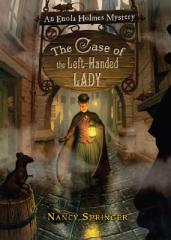
  • 9780399245176      The second installment of Nancy Spinger’s Enola Holmes series recounts the adventures of Sherlock Holmes’s younger sister as she travels the streets of London trying to solve the mystery of a kidnapped heiress.  The novel opens with Enola having fled from her brother Sherlock who holds the traditional views that she must commit her life to boarding school and then prepare herself for marriage.

    To retain her freedom, Enola strikes out on her own and goes into the detective business by setting up shop as one Dr. Ragostin, Scientific Perditorian (the term is obscure, but seems to mean someone who finds something that is lost) .  As she is female, she cannot be Dr. Ragostin himself, who does not exist anyway, so she artfully poses as his secretary and teases out the information from all of the potential clients that walk through the door.  This is how she gets her cases.  One of these customers is Dr. Watson, who does not recognize Enola, and acts as a proxy for Sherlock to track down his missing sister.  Enola realizes that she must be crafty to elude her intelligent brother.

    Through her landladies, Enola hears of another mystery that captures her attention.  Lady Cecily, the daughter of a local wealthy family, has gone missing from her bed one night, a ladder found outside her window.  Donning a series of disguises, Enola is able to interview her parents and soon discovers that Lady Cecily has dealing with the underground labor movement in London.  A series of twists and turns ensue, but Enola is able to finally locate the young lady and discover that she is the victim of a power hungry villain.

    Readers looking for a strong female protagonist will relish these Enola Holmes books.  Enola is intelligent, cunning, and fiercely independent.  In fact, her name spelled backwards is ‘alone.  Older readers may appreciate how Springer has obviously done her homework in bringing late nineteenth century London to life.  From the fashion to the different dialects, one feels immersed in the seedy and dark side of this dangerous city.

    I’d recommend these Enola Holmes mysteries to readers ages 9 to 11 looking for a historical mystery series featuring a strong heroine.

  •   This is a bloody good book.  Literally.  Hansel and Gretel are the main characters, but their story is not confined to just meeting the witch with the candy house in the forest.  Rather, Gidwitz mines the complete collection of the Grimm’s Fairytales and has the brother and sister show up in stories with which younger readers will probably be unfamiliar.  Along the way, heads are cut off, fingers are severed, and people are cooked.  Because of this reason, this book may be too much to handle for younger readers (in fact, the narrator pops in and out warning the reader to keep the younger kids away).   I would definitely recommend A Tale Dark and Grimm to older readers looking for updated fairytales with a lot of blood.  Grades 5+

  •   Brendan Buckley is a ten year old boy interested in rocks and Tae Kwon Do.  He keeps a journal called  Brendan Buckley’s Book of Big Questions About Life, the Universe and Everthing In It.  Lately he’s had plenty of questions for that journal.  While at the mall looking at a rock collection, his grandmother vigorously drags him away from an old man.  Brendan realizes that the man is his estranged granfather of whom no one in his family speaks well.  Using his curious and scientific mind, Brendan questions his mother and other family members in an attempt to figure out what happened between his grandfather and the rest of the family.  He soon discovers that it might have something to do with his racially mixed family.

    I found this book pretty slow going.  I just didn’t feel any real energy to the book, any real crisis that moved the plot along.  I would, however, recomend it to readers who are looking for a book involving rock collecting or Tae Kwon Do.  Ages 9-11  Corretta Scott King New Talent Author Award Winner 2007

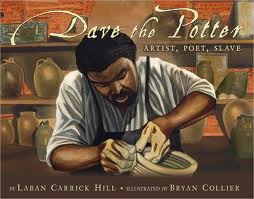
  • I finally got around to taking a look at some of the Caldecott finalists for this year.  I truly enjoyed the lively Interrupting Chicken, but Dave the Potter: Artist, Poet, Slave has really captured me. Laban Carrick Hill’s spare prose captures the mysterious character of Dave, his art, and his circumstances.  A slave in South Carolina in the 19th century, Dave spends his time making clay containers and inscribing small poems on the side of some of them.  Bryan Collier’s award winning art combines painting and collage to give life to Dave’s world.  As we read along, we discover that pottery is his balm and escape from his cruel circumstances.  Perhaps Dave best expresses his pain and hope in this simple poem he etches into the side of a jar in 1857: “I wonder where is all  my relation/  friendship to all—and, every nation.”  This book gave me goosebumps.

  • It is the summer of 1959 and Bobby and his brother Ricky are on a road trip with their mother and grandmother driving from Cleveland, Ohio down to Florida.  The reason for the trip is to drive grandma back home, but on their way they are touring Civil War battlefields.

    Much farther south, an African American boy by the name of Jacob is taking the bus from Atlanta to go visit some relatives that live out in the country in Dalton, Georgia.   He will spend a week there fishing with his uncle and spending time with his cousin.

    Despite the seemingly pleasant circumstances surrounding both of these trips, each boy soon finds that disturbing events are beginning to affect their lives.  Touring Civil War battlefields across the country, Bobby slowly realizes that his mother has decided on this trip to get them away from their abusive father and for her to decide if she wants to end the marriage.  While in Dalton, Georgia, Jacob discovers that his big city behavior, his whistling and carrying on, does not sit well with the white people in the small town.

    As the book progresses, the reader slowly realizes that we are watching these families geographically moving towards each other and, perhaps, to an explosion of violence.  The tension soon rises on both sides.  Bobby’s mother crashes the car outside of Chickamauga in a spasm of fear trying to drive away from some well intentioned black people.  They will have to take the bus home.  Meanwhile, Jacob has turned up missing in Dalton.  His family back in Atlanta boards the very same bus in hysteria knowing, just knowing, that their boy has been killed by some country whites.

    Author Tony Abbott deftly builds up each of the characters, exposing a history of violence and abuse in both families.   The ending is as touching as it is painful and leaves open the questions of how these young men will continue to navigate a world and society that is fundamentally unjust.  Excellent YA literature dealing with racism, family ties, abuse, brothers, and road trips.


  • This is an incredible book.  Kehret has the reader hooked within the first few pages.  I actually got queasy reading about how polio took over her 12 year old body.  Little Peg is moved from hospital to hospital as the symptoms from polio overtake her.  The reader watches as her fever eventually subsides, she is taken out of an iron lung, and she is subjected to therapy treatments that seem nothing short of torture.  The most touching part of the book are the friendships that she makes in the hospital.  Recommend for grades 4+

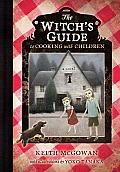
  •  A wonderful, modern twist on Hansel and Gretel.  Sol and Connie have moved with their father and stepmother to a new town.  The neighbor next door, Ms. Holaderry, seems a bit funny, especially when Sol realizes that her dog has been gnawing on a human femur!   After a few visits to their local public library (!!), the children surmise that she is indeed an evil witch.

    I truly enjoyed this book.  McGowan is able to preserve the simplicity of the old tale while also updating it for a modern audience.  For such a quick read, the book still manages to build the characters so that the reader becomes invested in them.   One especially strong point of the book is the old lady at the local curiosity shop.  She is the “good witch” of the story who is able to indirectly aid the children in their attempts to evade Ms. Holaderry.  I truly enjoyed this delightful fairy tale.  Ages 9-11

  • Ten year old Anya has a secret that she wants to keep: she’s wearing a wig.  Her real hair has begun to fall out due to an auto immune disease known as Alopecia Areata.  School is hard enough, but when you don’t have hair, the thought of facing your peers is almost unbearable.  Anya struggles to maintain her composure in the face of various obstacles: the constant itching of her scalp, gym class, and the stares of the class bully Steph Englewood.  Margaret Peterson Haddix does an excellent job presenting how children feel as outsiders.  I enjoyed reading this sometimes painful glimpse into the world of people that don’t fit in.  Ages 8-11

  • During this entire book, I was awaiting for two things: 1) for Sam to die and 2) for the protagonist Tim to pick a side in the Revolutionary War.  But Sam doesn’t eat it until page 208!  And Tim never makes up his mind whether he wants to be a Tory or a Rebel.

    The first half of this book is rather slow.  Much of it takes place in the town of Redding, Connecticut during the outbreak of the Revolutionary War.  Tim’s brother Sam has decided to defy his father’s wishes and enlist in the Continental Army.  Tim feels torn over who which side to support and his ambivalence only increases when his father is kidnapped by Rebel outlaws and a group of British soldiers brings havoc to Redding.  The last third of this novel is worth the slow beginning.  Younger readers may be rattled by some of the graphic violence.  Overall, a great historical fiction read for ages 9 to 12.   It truly earns its place as a Newberry Honor Book of 1975.