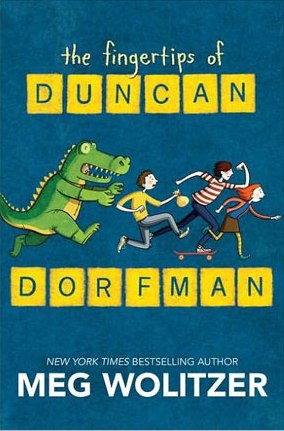
• You may not think that a book about Scrabble would keep you turning the pages, but Meg Wolitzer’s The Fingertips of Duncan Dorfman kept me engaged.

    Duncan and his mother have just moved across the country to Drilling Falls, Pennsylvania to live with Aunt Djuna.  Just as he is settling into his new school,  Duncan discovers that he has a secret power: his left hand is able to read the words and pictures on a page just by moving his fingers across them.  When school bully and hardcore Scrabble player Ken Colter discovers this ability, he convinces Duncan that he could be amazing at Scrabble.  His magic fingertips would allow him to choose whatever word tiles he wanted from the tile bag.  Ken and Duncan are soon on their way to the national Scrabble tournament in Yakaminee, Florida.  But Duncan is unsure whether he wants to go, and if he does, will he be able to put up with Ken’s bullying and use his super power to cheat their way to the finals?

    This book has other interesting characters that all meet at the Scrabble tournament.  Wolitzer deftly juggles these different storylines while managing to keep the plot moving forward.  I especially liked how the author’s obvious love of words and the game of Scrabble came through.  Readers will appreciate some of the clever wordplays.  Who knew, for instance, that MARASCHINO is an anagram of HARMONICAS?

    Themes explored in this book include bullying, missing fathers, discovering your talents, and first crushes.  I definitely recommend this book to readers ages 10 and above.

    294 pages.  Published 2011.

  • Although I try to focus on recent Children’s and YA literature, I do slip the occasional classic into my reading mix.  I self consciously admit that there are many classics that I have not opened.  I wish that I was one of those Children’s Librarians who can truthfully claim that they have powered through all of the books of OZ and spent time with Anne of Green Gables, but I am not one of them.  I hope to be one day though!

    Concerning From the Mixed-Up Files of Mrs. Basil E. Frankweiler, this book grew on me.   I confess that I was halfway through and wondering why it won a Newberry and why it continued to remain popular, but by the end, Konigsburg had won me over.

    The plot involves two children, Claudia and Jaimie Kincaid, who run away from home and spend a week in New York City’s Metropolitan Museum of Art.  They bathe in the museum fountain, eat at the snackbar and sleep in a 15th century bed at night.  After a couple of days of tagging along with school groups, they become captivated by the museum’s recent addition of a small angel sculpture that could possibly have been carved by Michelangelo.  Claudia becomes intent on returning home only after they solve the mystery of whether it truly was sculpted by the Renaissance master.

    I enjoyed the sense of low key adventure as the children runaway and hide in the MOMA.  Who hasn’t ever wondered what happens in museums or other public places when the crowds leave?  I also appreciated the children’s powerful curiosity as they become determined to learn everything that they can about the Italian Renaissance.  Claudia and Jamie remind us that we do not have to travel far to find excitement and wonder.

  •      I often enjoy books that immerse me in other times and cultures, especially when I know very little about them.  Having little knowledge of modern politics in Haiti, Frances Temple’s A Taste of Salt was an engaging and eye opening book for me.

     The story centers around two young characters: Djo and Jeremie.  Djo is a young man who has grown up in the streets of Port Au Prince.  Abandoned by his family from an early age due to their poverty, Djo finds a home at Lafanmi Selavi, a shelter set up by the Catholic priest Jean –Bertrand Aristide.   Having a little schooling, Djo is able to become a teacher there, instructing the other street boys in reading and writing.  As time passes, Titid (Aristide) begins speaking out more and more on the injustices in Haiti.  Titid and his street children, including Djo, are marked for attack by the prevailing political order and their terrifying henchmen the Tonton macoutes.   But there are other threats as well as Djo learns when he is kidnapped, and transported to the Dominican Republic to cut cane on a sugar plantation.

    Jeremie, a young woman in Port Au Prince, is also born into poverty, but her home life is more stable.  Her mother and aunt push her to work hard in school in the hopes that she will pull herself out of La Saline, the name of the slum in which she lives.  With this in mind she wins many awards in school, but she finds that she cannot escape the brutal political violence of Haiti.  After witnessing a massacre at a voting location and then the destruction of Titid’s church St. Jean Busco, Jeremie realizes that she must use her energy to help transform Haiti.

    I thought that this book was an excellent read because it was both entertaining and educational.  I particularly enjoyed reading about Djo’s resourceful ways in which he deals with the horrendous life of cutting cane in Dominicae.  A Taste of Salt was published in 1992 and won the Jane Addam’s Children’s Book Award.  I’d recommend it to any young reader who wants to know more about Haiti, how underprivileged people cope with a dictatorial regime, and whether change is possible in broken societies.

  •   Do you ever have nightmares?  Felix has nightmares every night.  They are always the same.  He is in a wooded area strewn with boulders and stone steps.   At some point a huge monster shows up and gives chase to him through the dark forest.

    Things aren’t necessarily better in the real world either.  He often hears his parents arguing over the status of his father’s job.  The project that his dad is working on isn’t going well and he may lose his job and they would have to move to another city.

    There’s also a new boy in school named Chase.  He is big and gruff and it isn’t long before Felix watches him steal a class calculator.  That same calculator later shows up in Felix’s backpack and the teacher understandably blames Felix for the theft.

    With all of this stress, his dreams at night are only getting weirder.  In the dreamland of the monsters, he meets his doppelganger.  This “Other Felix,” as he calls him, looks just like him, except he is dirtier, has survival skills and knows how to scare off the monsters.  Because of this, he enjoys the Other Felix’s company and learns a lot from him.

    But the relationship between the two Felixes begins to shift over time.  As the real Felix begins to spend more time in the dreamland, the Other Felix loses his power over the monsters.  He also grows increasingly surly as he hears more about the real Felix’s life at home with his family.  The Other Felix knows that he will never enjoy such comforts and only have a life spent in the woods with the monsters.

    Can Felix reconcile his real world and dreamland problems?  Can he find a way to deal with the bully at school?

    I enjoyed this book because it tackles typical Juvenile Fiction themes without being sentimental or maudlin.  I was mostly captured by the relationships between the two Felixes and how they struggled to defeat the dreamland monsters.

    I recommend for ages 8-10.

  •    Nolan is in 5th grade now and sick of Bubba Bixby picking on everyone in the school.  Bubba lies, steals, cheats and has a pejorative name for all of his classmates.  Nolan is half the size of Bubba, so a physical confrontation is out of the question.  How can he stop Bubba’s bullying without getting pounded into the ground?

    His answer comes when his hippie teacher Mr. Greene assigns them a project of creating a newspaper page on a topic affecting the community.  Nolan realizes that there is no greater issue to address than Bubba’s bullying.  He also decides that he’ll take the project one step forward by creating a website rather than just a newspaper.  Mr. Green has once written on his homework, “You shred, man!”  He decided that this was seriously high praise from a cool guy like Mr. Green.  In that vein, Nolan decides to adapt the appellation “Shredderman” for his online alter ego.

    Nolan builds the website Shredderman.com and begins posting pictures and videos of Bubba’s bullying.  All goes well until Nolan advertises his website a little too effectively.  Suddenly everyone is looking at his site and wondering who this Shredderman is.  He even receives an e-mail from Bubba: “I know who you are…You’re gonna wish that you were never born!”  Has Nolan suddenly taken his school project too far?

    Fans of such titles as as Oggie Cooder by Sarah Weeks and Hank Zipzer by Harry Winkler will appreciate the Shredderman series.  Secret Identity is also a great pick for readers that want to read about turning the tables on a bully.  Recommended ages 9+  138 pages

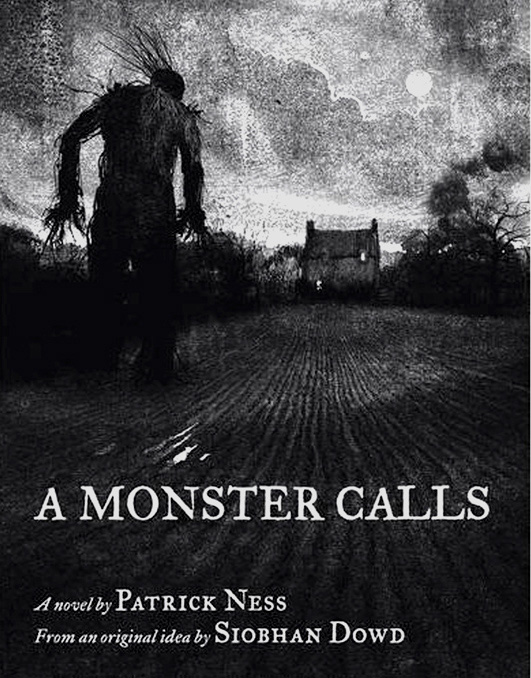
  •  The monster comes just after midnight for thirteen year old Connor O’Malley.  The yew tree in the church yard across from his house folds itself into the shape of a large man and lowers its eye to Connor’s window.  It demands his attention.

    But that isn’t the scariest thing in Connor’s life right now: his mother is dying from cancer.  She scarcely has the strength to make it out of bed these days and the new treatments don’t seem to be working.  His grandmother, abrupt and not inclined towards sweetness, has begun visiting more frequently to help out and make Connor’s days more unbearable.  His father, who lives in America, has also made plans to come see him through this difficult time.

    Things are also going terribly at school.  The local bullies, sensing his sorrow, have made a target of him.  But perhaps their attention is almost better than being ignored by the rest of his classmates.

    And then there is the monster.  It says that it will tell him 3 tales.  And then Connor must tell it the 4th.  These stories, through their confusion and harsh realities, disrupt him even further and put him face to face with his most dreaded nightmare of all.

    I loved this book, but felt that it was really an adult novel.  It wasn’t the language or content, but rather the theme of death and sorrow that makes it more inclined towards older readers.  This is a sad tale, but I found it cathartic.

    Ages 13+ Young Adult Fiction

  • Ten year old Sasha Zaichik’s greatest dream in life is to become a Young Soviet Pioneer.  His father works for the State Security and joining the Pioneers would make Sasha’s father proud and be an important step in following him in becoming a good Communist under Stalin.  The mother having passed away years before, Sasha and his father live in a komunalka, a communal living apartment.

    Sasha’s life changes when police show up one night and arrest his father.  Their room is taken over and Sasha is thrown out in the snow.  Turned away by relatives that same night, Sasha looks forward to the next day at school when he will become a Young Soviet Pioneer in the initiation ceremony.

    But Sasha’s luck does not improve at school.  While carrying the Soviet banner, he accidentally breaks the nose off of a Stalin statue.  Hiding the misdeed, Sasha’s actions set off a school wide emergency as the administration struggles to pin the blame on someone.

    Yelchin does an excellent job capturing the fear, paranoia, and dark humor of the U.S.S.R during Stalin’s reign.  I found particularly compelling the anger and resiliency of Sasha’s classmates.  These children, so beyond their years in their concerns, do everything they can to baffle, in their own small way, Stalin’s system of terror.

    An excellent choice for children interested in Soviet history.  I would also recommend to a parent or a teacher trying to show students what a society is like without freedoms and liberty.   A Newberry Honor for 2012.  Ages 9+

  • Image

    This is a verse novel narrated by a young girl set in the 1950’s and 60’s in Hong Kong.   Written almost as a verse diary over several years, the reader gains a glimpse into the girl’s life.  Her family subsists mainly from her father’s tailoring business, but work ebbs and flows.  When the father is not working, he makes patchwork blankets that the girl calls ‘tofu quilts.’  Despite money being tight, her mother manages to send the girl to private school where she develops a love of books.  Her dream is to grow up someday to become a writer.

    Family tensions are explored as the girl describes her father’s family becoming upset with the mother for sacrificing so much on the narrator’s education.  Gender is also touched on as relatives counsel the girl to respect her elders and to one day obey her husband.

    Readers will appreciate the unique verse form of this novel.  I did not find this book to be particularly interesting, but I did appreciate the clean, elegant writing style.  For ages 8+

  • Tree Ear is a boy who lives in a small village on the west coast of Korea in the middle of the 12th century.  He spends most of his time scavenging for scraps around local trash heaps and sleeps under a bridge at night.  His friend is Crane Man, an old man with a disabled leg who has taken care of Tree Ear since he was brought to the village years before by a monk.

    Tree Ear’s life changes when he begs a local potter named Min to take him on as an assistant to pay off a debt.  His days are then spent in hard manual labor cutting down trees or digging out blocks of clay along the river bank.  Tree Ear one day hopes to learn how to make pottery on a wheel, but Min gruffly refuses to teach him.

    When Min decides to show his pottery to the royal emissary in the capital, however, he must rely on Tree Ear to make this perilous journey.

    I loved this book and could tell why it won the 2002 Newberry Honor Award.  The different setting truly lent to its appeal.  I found the characters fully human.  I’d recommend this book to anyone looking for a good juvenile historical fiction book.

  •    Twelve year old Steve Brixton is a detective.  He’s learned his trade by reading all 58 volumes of the Bailey Brothers mysteries as well as pouring over The Bailey Brother’s Detective Handbook.  He has a magnifying glass, a notebook, and a keen eye for thugs and hoods.

    Steve’s detective skills are put to the test when his teacher assigns him an 8 page report on early American quilting.  Despondent over this task, he heads down to the local public library and checks out a book called An Illustrated History of Early American Quilting.  Suddenly, the library is attacked by a gang of masked henchmen!  They kidnap Steve and inform him that his book holds the clues to finding a priceless early American quilt.  Steve must call upon every sleuthing skill from the The Bailey Brother’s Detective Handbook to escape and solve the mystery.

    Author Mac Barnett does a wonderful job of spoofing the Hardy Boys in this new detective series.  This book is funny for both children and adults.  I eagerly recommend for kids ages 8+.