• thecaptureThe Plot:  Soren is a barn owlet born in the forest of Tyoto.  Living with his family in the hollow of a fir tree, he has many things to look forward to.  He has just had his “first fur “ceremony, in which he eats his first meal with fur in it, and it will soon be time for his “first bones,” in which he will be expected to regurgitate pellets, just like a healthy adult owl would.   After that he will begin to learn how to fly!

    But there are also problems in Soren’s life.  His older brother Kludd is a bully and at times seems to possess an even darker side that goes beyond that.  Soren worries about Kludd’s influence on their younger sister Eglantine.  There are rumors as well of a egg snatchings.  Someone or something has been raiding owl nests and stealing the eggs.  Such a things has never been heard of in the forests of Tyoto before.

     Soren’s life abruptly changes when he falls (or was he pushed by Kludd?) out of the nest one evening.  He is soon snatched up and carried aloft by a powerful owl who takes him to a stony place with deep, narrow canyons.  Hundreds of other young owls are there as well, all of them having been kidnapped from their homes.  He discovers out that this is “St. Aegolius Academy for Orphaned Owls.”   During the first full moon, the owlets are marched together outside.     Soren makes friends with an elf owl named Gylfie and together they discover that the Academy is trying to “moon blink” them, a process in which an owl basks in the moonlight and is made crazy.  The two owls discover other areas of St. Aegolius as well and realize that the Academy has a sinister purpose.  Soren and Gylfie must escape from this place and make it back to their homes to warn the other owls.

    Personal Reaction:  I have been wanting to read some of The Guardians of Ga’hoole series for some time and I was not disappointed.  Lasky keeps the story moving along at a brisk pace while managing to create a convincing fantasy world.  I appreciated that Lasky presents a great deal of factual information about owls, including some of the not so appealing topics of regurgitation and excretion.  These bathroom subjects are approached in such a way that the young readers will understand that these are important part of the owl’s lives and not just put in the book for comedic material.

    Themes:  desire for power, orphans, bullies, kidnaping, creating new family,  enslavement,  searching for home.

  • manicamagee Plot: Jeffrey Magee is a an orphaned boy who blows into the town of Two Mills, Pennsylvania (a fictional place) one afternoon. Within the first day he has already made an impression on the neighborhood. He butts into an ongoing little league game and hits line drives off of ace pitcher John McNab. He strays into Finsterwald’s backyard, a place that no other kid will venture due to the local grinch that lives there. And the Pickwell kids claim that they saw him running on top of the steel rails of the railroad tracks. With all of these crazy stories floating about, people begin calling him Maniac Magee.

    But Jeffrey soon hits upon the split reality of Two Mills: the town is divided strictly along racial lines of white and black. Maniac is oblivious to it all. Although being white himself, he openly wanders into the black part of town and remains oblivious to his blunder. He stays with the Beale family on Sycamore street until they begin receiving threats because they are housing a “honky fishbelly.” Maniac knows then that it is time to move on.

    He takes up residence in the bison pen at a local zoo, until he makes friends with the local groundskeeper, an elderly man named Grayson. During his weeks with Grayson, Jeffrey listens to his tales about playing minor league ball and he also teaches the old man how to read. When Grayson passes away, Jeffrey again hits the road and eventually ends up back in Two Mills. This time Maniac will examine even more closely the racial strife in the town and take action to ameliorate it.

    Personal Reaction: A couple of years ago I tried to listen to the audiobook version of Love Stargirl by Spinelli. I say “tried” because a couple of chapters into it, I found it to be so annoying that I turned it off. It may not have been the writing. It may have been the subject matter or the grating voice of the narrator.

    As I listened to the audiobook of Maniac Magee, I thought that I was going to have a similar reaction to this book. I enjoyed the opening when Jeffrey rolls into Two Mills like
    a supernatural event, performing heroic acts and getting everyone talking. Midway through, however, during the scenes with Grayson, I felt that Spinelli had lost the momentum of the narrative. I found the interaction between Maniac and the elderly groundskeeper to be cloying, especially when he was teaching him to read. Where was the hook, I wondered, to keep the reader, well, reading?
    The book picks up again when Maniac returns to Two Mills and encounters the racial conflict. At this point, older readers will realize that the character of Jeffrey is really not much of a character at all. He is the personification of racial tolerance and color blindness. He is the unearthly hero who can perform great miracles and open people’s hearts. I appreciated Spinelli asking readers to make this leap to study the symbolism surrounding the character of Maniac. For this reason, I can understand why this book is taught in many middle school classrooms and also won the 1991 Newberry Honor Medal.
    Themes: racial conflict, heroism/heroic acts, orphan, individual vs. society, community healing.

  • Jasper Dash_flame pits     Maybe you’ve been to that small wonder of the state of Delaware a time or two.  Perhaps you even reside there.  But you’ve never been to the one as crafted by M.T. Anderson in Jasper Dash and the Flame-Pits of Delaware.   This Delaware is “a realm of wonders and terrors, a land that time forgot, or chose specifically not to remember.” (98)  Filled with majestic mountains, deep forests, icy bluffs and frigid cliffs, this land is indeed a challenge for our three intrepid high school heroes: Jasper Dash, Katie Mulligan and Lily Gefelt.  You may remember these three as the stars of Whales On Stilts and The Clue of the Linoleum Lederhosen.

         As the Flame Pits of Delaware opens, the reader finds that Jasper has joined his local Stare Eyes league, a competitive sport based around who can stare the longest at the other person without blinking.  Jasper’s team is on the way to becoming state champions but they must face their final opponents, the formidable Delaware Stare Eyes team.

        During the competition, Jasper receives a telepathic communication from his old friend Dragan Pghlick.  It is a cry for help.   All the while, Katie observes the Delaware Stare Eyes team trying to sell some precious treasures to the local museum.  These Stare Eyes champions are clearly not what they appear to be.  Jasper soon deduces that they are part of a group that has overrun the lost monastery of Vbngoom located in Delaware.  This monastery is home to his friend Dragan and also the source of the famous flame pits that can bequeath awesome powers on the monks there.

    Jasper, Katie, and Lily are soon on their way to Dover, Delaware where they intend to locate and save Vbngoom.  The way ahead is fraught with peril as the three are stalked by secret agents, chased by dinosaurs, and tangled up in an eldritch demon-spawn.  They eventually find the monastery and must come face to face with Jasper’s oldest and most faithful foe.

    Younger readers will appreciate the sense of adventure throughout the book.   Intelligent children and adults will enjoy the immense amount of wit that Anderson has embedded in the text.  The character of Jasper Dash , for example, is a sincere character based on 1950’s comics.  He cannot fathom the laughter of his Stare Eyes teammates when he shows up in the locker room “wearing a space-age uniform involving tubing and silver sparkles” (32).  His out of touch earnestness creates comedy all through the novel.

    I would recommend Jasper Dash and the Flame Pits of Delaware to advanced readers ages 9+.  Themes:  friendship, the strangeness of the familiar, double identities, heroism, good vs. evil.

  • ImageSynopsis: The first installment in a promising series, The Mysterious Howling by Maryrose Wood is the story of a nanny and her 3 unique charges at an English estate in the early 19th century.

    Penelope Lumley is a 15 year old graduate of the Swanburne Academy for Poor Bright Females.  Seeking work, she interviews at Ashton Place, a grand house set on thousands of acres.  She soon discovers, after quickly being hired, that the 3 children for which she is responsible are in fact wild.  They were discovered in the woods on a hunting trip by Lord Frederick, the owner of Ashton Place, who has since kept them in a barn.  

    Getting right to work, Penelope cleans them up and urges Lord Frederick to choose names for them.  He decides to call them Beowulf, Cassiopeia and Alexander, but refers to them as the Incorrigibles in the collective.  There is an immediate bond between the nanny and children and she makes great strides in their education.  Her skills as a governess are soon tested, however, when the lady of the house, Charlotte, informs Penelope that there will be Christmas ball at Ashton place and that she expects the children to display impeccable manners as well as know how to dance “the schottische.”

    Of course this is asking too much and the Christmas ball devolves into bedlam.  It does so in such a way, however, that it calls attention to the mystery surrounding the Incorrigibles and Ashton Place.  By the end of the book, Penelope is faced with several questions:  who are these children?  Is Lord Frederick trying to hide something?  And what is that scratching behind the walls upstairs?

    Personal reaction:  This is a quirky, clever book that both children and adults will enjoy.  Older readers will appreciate Wood’s witty humor.  I laughed several times when reference was made to the unique aphorism’s coined by the founder of Penelope’s alma mater Agatha Swanburne.  Several of Ms. Swanburne’s sayings include: “complaining doesn’t butter the biscuits” and “a well-organized stocking drawer is the first step to a well-organized mind.”   Children will appreciate the comedy that ensues when the feral Incorrigibles slowly acclimate to civilized life.  Ages 9-11 Themes:  the pressures of refined society on children, adoption, feral children.

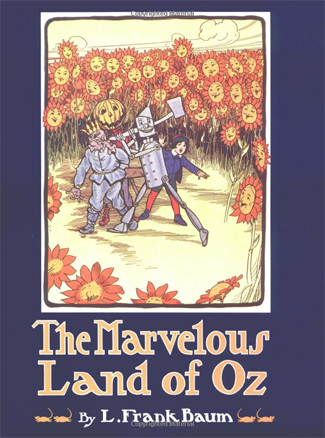
  • I continue my Oz reading with this second installment of Baum’s fantastical world.  I know that I’ll read at least one more if not two in the series.

    Plot:  Let’s get one thing out of the way: Dorothy is not in this one.  Our story opens in the Country of the Gillikins, the northern land of Oz, and follows a boy name Tip as he escapes from his cruel master, the witch Mombi.  Before leaving, Tip steals some magic powder which he uses to animate a pumpkinhead man that he has made.   Their plan is to travel to the Emerald City to meet the Scarecrow, who is now the ruler of that place.  Along the way, they animate a saw horse and ride him to the City.

    They meet the scarecrow who unfortunately is not much help as his city is quickly overthrown by an army of girls with knitting needles.  They all escape to the land of the Winkies where they meet the Tin Woodsman who rules there.  They return to the Emerald City but are quickly surrounded by the girl army, escaping by creating a flying machine out of various items including the head of a gump.  Eventually they make it to the south country where they meet with Glinda the Good who accompanies them take back the Emerald City from both the girl army and Mombi.  There is an excellent plot twist at the end that I will not spoil for you.

    Personal Reaction:  I felt that this book was different from the first in that L. Frank Baum seemed more sure of the tone that he wanted to strike.  In the Wizard of Oz, the story often overwhelmed a great deal of character development (“and then this happened…and then this happened…”).  But Baum allows The Marvelous Land to breathe a bit more and lets the characters have extended conversations that illuminate their personalities.  One dialogue that I found enjoyable was early on in the book when the Scarecrow and Jack Pumpkinhead are first meeting.  They talk themselves into the idea that, because they are from different lands of Oz, then they must need an interpreter to understand each other.  Of course, they are speaking the same language the entire time.

    I also appreciated how each character was proud in their own way of their uniqueness, but also inclined towards sensitivity on this matter.  The Tin Woodsman, for example, has himself nickel plated and is careful to avoid scratches to preserve his lustre.  Jack Pumpkinhead is careful not to damage his head and is constantly worried about spoiling.  The Sawhorse is embarrassed when one of his legs is damaged and must be switched out with another piece of wood.  Baum’s characters wear their weirdness on the outside, but just like people, are inclined to be self conscious about it.

    Taken all together, I believe that this book holds up (a bit of sexism concerning the girl army notwithstanding) over a hundred years later.  I can cheerfully recommend The Marvelous Land of Oz to 7 year olds and up.

    Themes:  uniqueness, diversity, character identity, female empowerment, gender identity, the trials of teamwork,

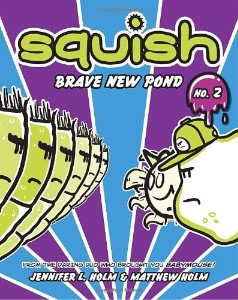
  • Jennifer L. and Matthew Holm continue the amusing tone set in their Babymouse graphic novels with their new series Squish.  Last week I read the first two installments to my 5 year old daughter.

    Plot: Squish is a young amoeba who lives in a pond floating with other microorganisms including paramecium and planaria.  But life in the pond is not easy and Squish is plagued with troubles familiar to any human child in elementary school.  In the first book, Squish must face down the school bully Lynnwood, also an amoeba, who wants to eat his obnoxiously ebullient friend Peggy, a paramecium.  In the second book, Squish is starting a new school year and finds that he has made it into the cool crowd with the Algae, the “coolest microorganisms in the pond.”  But Squish soon finds out that being with the popular kids comes with a price that is too high for him to pay.

    Personal Reaction: These are fun, clever reads.  I love the artifice of using the microscopic world of a pond as an allegory for the trials of elementary school.  Lynnwood is the scariest amoeba in school because he readily, and quite literally, eats and digests other microorganisms.  The Algae are the coolest kids  because they produce oxygen.  As an adult, I found it entertaining to reconsider the life of an amoeba, something that I had not thought about since 9th grade biology class.  Kids will enjoy the comic book spoof humor and the problems that relate to this age group.

    Themes: following your conscience, bullying, standing up for your friends, father-son relationship,  the effects of the inner life of the mind on the outer world, fitting in with social groups, the shifting nature of friendships under pressure.

    Squish: Super Amoeba 94 pages 2011 Random House; Squish: Brave New Pond 90 pages, 2011 Random House.

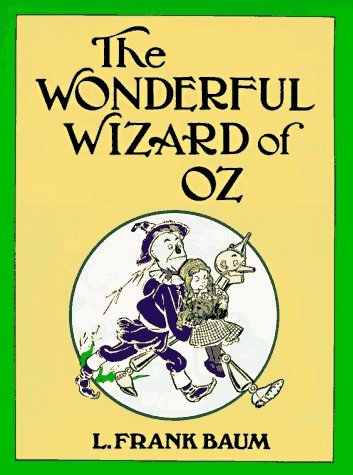
  • Any children’s librarian worth her salt (or his salt, in my case) needs to be familiar with L. Frank Baum’s classic The Wizard of Oz.  For my part, I have decided recently to read at least the first 3 or 4 books in the series.  I wanted to move beyond the initial book that Hollywood has so well acquainted us with and truly experience the strangeness of Baum’s imaginary world.  With this in my mind, I put the Wizard of Oz in my suitcase as I packed for my vacation last week.

    We are all by now familiar with the story: a cyclone sweeps up the Kansas prairie girl Dorothy, her dog Toto and their house and deposits them in the magical world of Oz.  Upon landing in the country of the Munchkins, Dorothy learns that she must travel to the City of Emeralds and seek the help of the great Oz.  She meets some companions along the way in the form of a scarecrow, a tin man, and a lion. That is all that I will say about the plot, because you know it anyway.

    My own reaction to Baum’s classic is that it holds up pretty well since its publication in 1900.  I sometimes felt that events were a little forced (“and then this happened…and then this happened…”), especially near the end when the party travels through a land of living ceramic people.  I couldn’t help but wonder why Baum inserted that in there unless he was trying to set up plot points for future books.

    Ultimately I liked the message of uplift that pervades the story.  As Edward Wagenknecht writes in the Afterword, “all these people, and the cowardly lion too, when they wanted something, they went out after it and in the end they found it.”  And it’s true.  Each of the characters attains that for which they search.  The irony of course, often lost on children but clear to adults, is that each of the characters already had what they wanted.  The Scarecrow had brains, the Lion courage, the Tin Man had heart, and Dorothy had an adventure to deliver her from the tedium of the Kansas prairie.  What is Baum telling us?  That adventure is here and now?  That we already have what we so want?  I’m not certain, but I love when a children’s book pushes me into deeper waters like this.

    So, even an adult reader in 2012 can enjoy The Wizard of Oz.  I look forward to tackling at least the next two in the series.

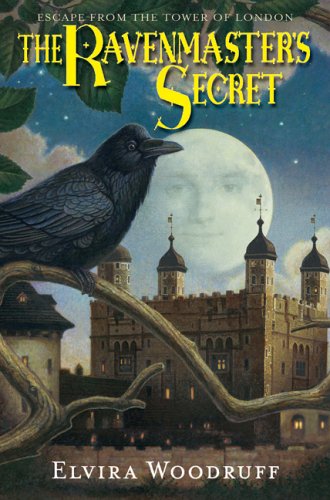
  • ImageSynopsis:  The year is 1735 and the place is the Tower of London.  Forrest Harper is an 11 year old boy who is the son of the prison’s Ravenmaster.  His days are spent tending to the birds, playing with his rat catching friend Ned, and providing meals to some of the prisoners.  Forrest longs for adventure and receives some when a group of Scottish prisoners are sent to the tower.  Amongst them is a girl named Maddy who soon fills Forrest’s ear up with tales of her home in Scotland.

    As the day of Maddie’s trial and execution approaches, Forest and Ned are tempted to become part of a plot to help her escape.  But there is so much at stake.  If they are caught, it would surely mean death for them and great shame for Forrest’s family.  What will they do?

    Personal Reaction:  Because I enjoy reading about history and other cultures, this was a quick and easy read for me.  Woodruff packs this book with bullies, thugs, and shady people.  She also does such an excellent job of building characters and moving the plot along that I truly wanted for Forrest, Ned and Maddie to prevail.  After I hit the midway point of this book, I just burned through the rest. I had goosebumps as I read the final pages.  I’m not sure that I can give a book higher praise than that.

    Themes include father-son relationships, testing of friendships, freedom vs. captivity, bullying,  the limits of patriotism, the morality of public executions, child labor, and child cruelty.

    225 pages; published 2003

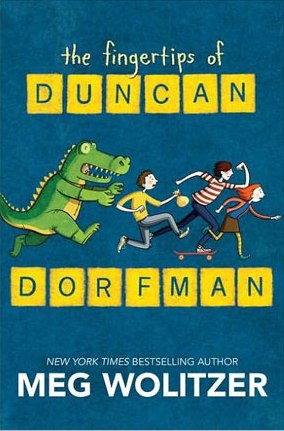
  • You may not think that a book about Scrabble would keep you turning the pages, but Meg Wolitzer’s The Fingertips of Duncan Dorfman kept me engaged.

    Duncan and his mother have just moved across the country to Drilling Falls, Pennsylvania to live with Aunt Djuna.  Just as he is settling into his new school,  Duncan discovers that he has a secret power: his left hand is able to read the words and pictures on a page just by moving his fingers across them.  When school bully and hardcore Scrabble player Ken Colter discovers this ability, he convinces Duncan that he could be amazing at Scrabble.  His magic fingertips would allow him to choose whatever word tiles he wanted from the tile bag.  Ken and Duncan are soon on their way to the national Scrabble tournament in Yakaminee, Florida.  But Duncan is unsure whether he wants to go, and if he does, will he be able to put up with Ken’s bullying and use his super power to cheat their way to the finals?

    This book has other interesting characters that all meet at the Scrabble tournament.  Wolitzer deftly juggles these different storylines while managing to keep the plot moving forward.  I especially liked how the author’s obvious love of words and the game of Scrabble came through.  Readers will appreciate some of the clever wordplays.  Who knew, for instance, that MARASCHINO is an anagram of HARMONICAS?

    Themes explored in this book include bullying, missing fathers, discovering your talents, and first crushes.  I definitely recommend this book to readers ages 10 and above.

    294 pages.  Published 2011.

  • Although I try to focus on recent Children’s and YA literature, I do slip the occasional classic into my reading mix.  I self consciously admit that there are many classics that I have not opened.  I wish that I was one of those Children’s Librarians who can truthfully claim that they have powered through all of the books of OZ and spent time with Anne of Green Gables, but I am not one of them.  I hope to be one day though!

    Concerning From the Mixed-Up Files of Mrs. Basil E. Frankweiler, this book grew on me.   I confess that I was halfway through and wondering why it won a Newberry and why it continued to remain popular, but by the end, Konigsburg had won me over.

    The plot involves two children, Claudia and Jaimie Kincaid, who run away from home and spend a week in New York City’s Metropolitan Museum of Art.  They bathe in the museum fountain, eat at the snackbar and sleep in a 15th century bed at night.  After a couple of days of tagging along with school groups, they become captivated by the museum’s recent addition of a small angel sculpture that could possibly have been carved by Michelangelo.  Claudia becomes intent on returning home only after they solve the mystery of whether it truly was sculpted by the Renaissance master.

    I enjoyed the sense of low key adventure as the children runaway and hide in the MOMA.  Who hasn’t ever wondered what happens in museums or other public places when the crowds leave?  I also appreciated the children’s powerful curiosity as they become determined to learn everything that they can about the Italian Renaissance.  Claudia and Jamie remind us that we do not have to travel far to find excitement and wonder.