• timmyfailureGenre: Comedy
    Series? No
    Audience Age: 8-11
    Rating: 4

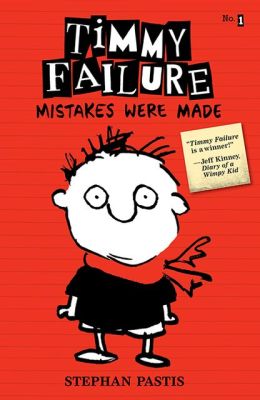
    The story in no more than five sentences:  Timmy Failure is the founder and president of Failure Inc., a detective agency that he runs out of his mom’s closet.  Failure Inc. is a rather unique business in that Timmy’s detective partner is a polar bear named Total, and his company vehicle is his mom’s segway (which she has expressly forbidden him to use!).  Timmy’s greatest problem in life is evading and defeating his arch nemesis Corrina Corrina who runs a rival cross town detective agency.   But his troubles only multiply when his mom, in response to his poor school performance and her segway being stolen, forces Timmy to shut down his detective agency and donates Total to the local zoo.  Can Timmy solve the mystery of the stolen segway so that he can save his best polar bear friend and his business?

    The best part of this book in one sentence:  The best part of this book is the spot on, dead pan humor so effectively employed by the author.

    The worst part of this book in one sentence:  Some parents may be concerned by the use of the word “failure.”

    One interesting note about the author:  Stephan Pastis is creator of the comic strip Pearls Before Swine which appears in over 600 newspapers.

  • Image


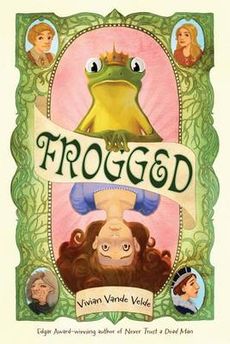
    Genre: Fairytale Fiction


    Series? No


    Audience Age: 7-11


    Rating (1-5):  2 


    The story in no more than five sentences: Princess Imogene Eustacia Wellington meets a talking frog near a pond who claims that he is a prince who has been turned into a frog by a witch.  When Imogene kisses him, the spell reverses by turning her into a frog instead!  Imogene tracks down the witch who takes responsibility for the spell but refuses to help her.  A group of traveling players then kidnaps the Princess frog.  After several abominable productions around the kingdom, Imogene escapes, is reunited with her family, and eventually casts off the spell by kissing a frog.

    The best part of the book in 1 sentence:   The best part of this book is the convincing characterization of Imogene, who is not too sweet, not too cynical as she tries cast off the spell without inflicting it upon someone else.


    The worst part of the book in 1 sentence:   I found the middle part of the book in which she is traveling with a group of players tedious after awhile.  

    1 interesting note about the author:  The name Vivian Vande Velde is a mouthful!  You may hear her pronounce her name here at teachingbooks.net

  • My Happy LifeGenre: Realistic Fiction

    Series? No
    Audience Age: 7-9

    Rating (1-5):  4

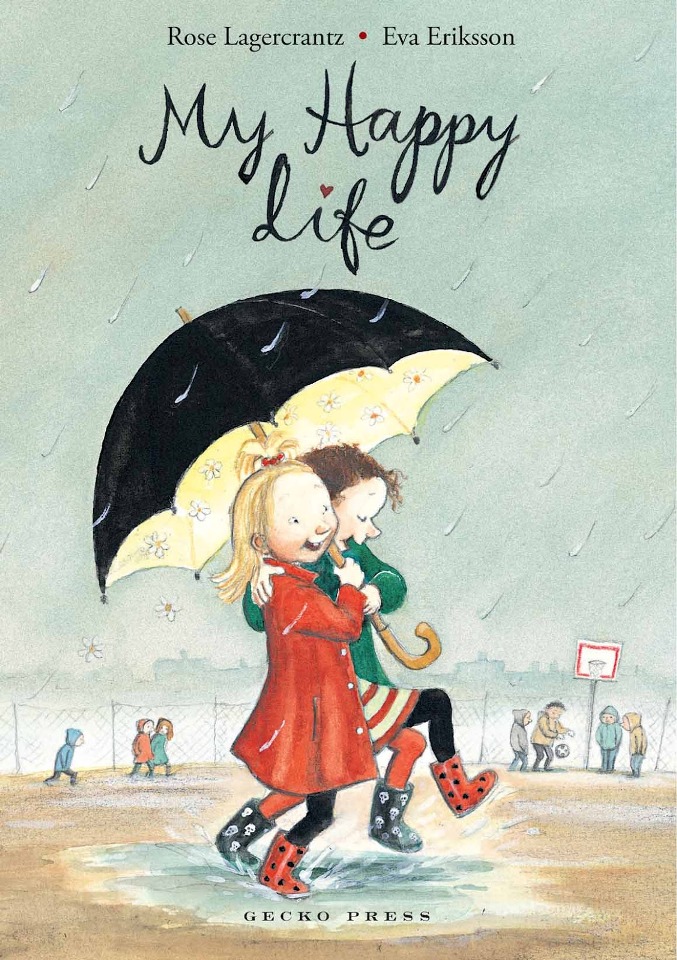
    The story in no more than five sentences:  Dani, a girl who is about to start Kindergarten, lives with just her dad and their cat since her mom passed away.  She is very nervous about starting school, but becomes much happier after she befriends Ella.  They do everything together including swinging, trading bookmarks, and playing with Ella’s hamster Partyboy.  But in the middle of the year, Ella has to move away.  Dani is incredibly distraught until a series of events shakes her from her sadness and moves her towards other, different friendships.

    The best part of the book in 1 sentence:  The strongest part of this book is Langercrantz’s plain writing style that perfectly expresses Dani slowly adjusting to her loss.  The pen and ink illustrations by Eva Eriksson also warrant mentioning.

     The worst part of the book in 1 sentence:  I honestly cannot think of anything outrageously bad about this book.

     1 interesting note about the author:  Lagercrantz and Eriksson are both Swedish and have been writing children’s books together for a long time.

  • See you at Harry's

    Genre:  Realistic Fiction

    Series?  No

    Audience Age:  12-16

    Rating (1-5):  3

    The story in no more than five sentences:

    Middle school for Fern is off to a bad start.   Her family owns a restaurant and her dad has created a commercial that features every member of the family shouting “See You At Harry’s!”  Her older brother Holden, mercilessly teased at school for being gay, seems to be withdrawing from the family and towards his much older boyfriend.  The one bright spot is that she is growing closer to her cute friend Rand and he has a way of making everything seem alright.  When a tragic event occurs, the bonds within Fern’s family are tested to their utmost limits.

     The best part about the book in 1 sentence:

    ­­­­­­­­­­The best part of this book is the realistic and open portrayal of Holden’s sexuality in High School.

    The worst part of the book in 1 sentence:

    The worst part of this book is the cover that does not capture the inner tension within the book.

    1 interesting note about the author:

    Jo Knowles’s parents actually owned a restaurant in New Hampshire where she grew up.  Find out more at www.joknowles.com


  • Image Genre:  Comedy

    Series?  No

    Audience Age:  8-11

    Rating (1-5):  3

     The story in no more than five sentences:

    Frank and his family have moved to a new town again because his older sister Elizabeth suffers from Formus Disappearus, meaning that she is invisible.  Because of her condition, she rarely adjusts well to new social environments and consequently makes everyone else in the family miserable until they decide to move.  But this time Frank likes his new school and his new friend Charlie and has decided that he must do whatever it takes to ensure that Elizabeth is happy and that the family stays in place.  He helps the neighbors with babysitting and Christmas displays and makes excuses for Elizabeth’s bad behavior.  In the end, he is put to the test when his mom caters a huge town hall party and everything seems to fall apart.

     The best part about the book in 1 sentence:

    The best part of this book is when Elizabeth forces Frank to meet Brucey Bruce, the lead singer of the boy band Boys-R-Us!

    The worst part of the book in 1 sentence:

    The worst part of this book is that Elizabeth is sometimes a too difficult character to like because she comes across as a jerk with some, but in my view not enough, redemptive values.

    1 interesting note about the author: 

    Beatrice Colin writes mostly for adults and is refreshingly honest in how writing can be difficult:  “as I make my tenth cup of tea, and it’s only eleven am, check my email again and then download another track from itunes, I feel like a total fraud.” (from www.beatricecollin.co.uk)

  • In-Search-of-Goliathus-Hercules

    Genre:  Adventure

    Series?  No

    Audience Age:  10-12

    Rating (1-5):  3

     The story in no more than five sentences:

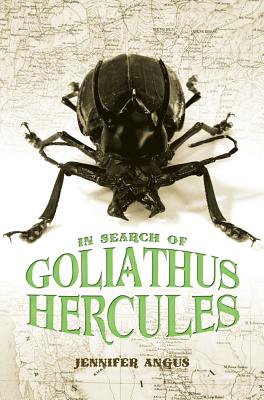
    When Henri’s father goes missing on an expedition to British Malaya, he is sent to live with his Great Aunt Georgie where he discovers that he possesses an extraordinary power:  he has the ability to talk with insects!   Deciding to go find his father in Malaya and discover the legendary giant beetle Goliathus Hercules, he leaves his Aunt Georgie and becomes a barker of a traveling flea circus, meeting several circus friends along the way.  Henri realizes that he is being followed by a sinister woman named Miss Black, who desires the Goliathus Hercules as much as he does.  He also notices that he cannot only talk to insects, but that he is actually transforming into one!  Traveling to Malaya, Henri and his friends discover the giant beetles, defeat Miss Black, and eventually learn that his father has transformed into a rare Goliathus Hercules.        

    The best part about the book is ( in 1 sentence):

    ­­­­­­­­­­The best part of this book is the fantastic and elaborate insect circus shows that Henri performs using all kinds of bugs.

    The worst part of the book is ( in 1 sentence):

    The worst part of this book is the final 50 pages of discovery about his father which seemed to drag the plot out unnecessarily.

    1 interesting note about the author:

    Jennifer Angus is a professor of Design Studies at the University of Wisconsin.  A lover of insects, she uses all kinds of bugs to make elaborate pattern art.  http://www.jenniferangus.com/home.htm

  • Image

    Genre:  Realistic Fiction

    Series?  No

    Audience Age:  Older Teens

    Rating (1-5):  4

    The story in no more than five sentences:

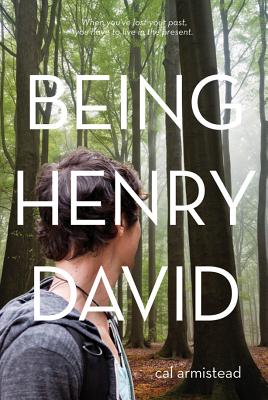
    17 year old Hank wakes up in Penn Station with no memories and no idea who he is.   The only thing in his possession is a copy of Henry David Thoreau’s Walden.  After falling in with a couple of street kids on the run, Hank makes his way up to Concord, Massachusetts to view the sight where Henry David Thoreau lived in the woods.  Hank makes friends with  a local Thoreau researcher and begins falling for a girl named Hailey.  But as he begins to enjoy his life in Concord, he begins to remember, and must come to terms with, his troubled past.

    The best part about the book is (in 1 sentence):  Armistead is adept at interweaving Thoreau’s philosophy into Hank’s troubled life and thereby making it meaningful to teen readers.  

    The worst part of the book is (in 1 sentence):  The opening plot device, boy can’t remember anything, may seem too pat for some readers.   

    1 interesting note about the author:  Cal Armistead lives in the Boston area, is a voice over actress, and semi professional singer.  Being Henry David is her first novel.  Find out more about her at www.calarmistead.com

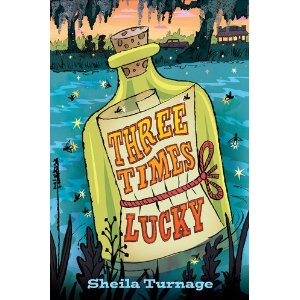
  • threetimesluckyPlot:  11 year old Moses LoBeau lives in the small town of Tupelo Landing, North Carolina.  She has lived there most of her life since she floated in (literally) during a hurricane when she was an infant.

    For this reason, Mo has never known her real parents, but she is content to help run the local diner with her adopted parents Miss Lana and the Colonel.   When not serving up a heap of sass and fried food at the cafe, her favorite pastime is going fishing with her best friend Dale.

    The small town life of Tupelo Landing is disrupted when the local grouch Jessee Tatum turns up dead in the creek.  Detective Starr and his sidekick deputy Marla arrive in town from Winston Salem determined to find and stop the killer.

    Mo and Dale decide to aid in the investigation by forming their own group, the Desperado Detectives.  They soon have their work cut out for them when both the Colonel and Miss Lana go missing.

    Personal Reaction:  I immediately had some reservations with Three Times Lucky from the very first chapter.  This was due to its treading upon territory overly familiar to anyone who reads children’s literature.  Turnage chose to write the novel in the first person and in a faux southern, rural style that seems so prevalent in juvenile and YA fiction but tends to wear on me quickly.  I’ve never met a child that speaks in the sassy similes of Mo Lobeau, but between Walk Two Moons and A Year Down Yonder, it makes me think that the Newberry Medal committees have a soft spot for this type of overwrought, country speak.

    Also, another well-mined theme of kid lit appears early on when we discover that the protagonist is an orphan and looking for her biological mother.  If I had a dime…

    My enjoyment of the book did not increase as I read further due to the elasticity of the plot.  When Mr. Jesse turns up dead, it is assumed that the killer must still be in Tupelo Landing, although no reason is given for this assumption.   Furthermore, when the identity of the perpetrator is finally revealed (with 100 pages of the book to go!), I could not help but feel that this character was awkwardly inserted into the plot.   Also, one of Mo’s pastimes is chucking note-filled bottles into the river hoping that her birth mother will find them.   Every time that she does this, I can’t help but think that a child as bright as Mo would sooner be down at the local public library on the computer searching for her mother on the Internet.

    Still, Turnage does have an ability to turn a phrase.  Dale fixes his eyes so hard on a car “like he could stare the shine right off of it.”  Another character’s voice seems “shaved from ice.”  I suspect this vivid phrasing helped this novel a great deal towards becoming a Newberry Honor book

    Themes:  orphan, double identities, lost pasts, who-done-it mystery, North Carolina/southern culture
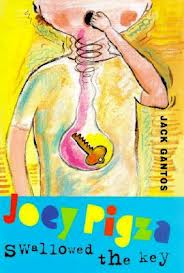
  • joey      Plot:   Joey Pigza is a boy who has ADHD.  He pulls out his hair, he spins through the hallways at school, and snatches flies out of the air.  His home life exacerbates his condition.  His father, who is an alcoholic, left when he was in kindergarten and his mother followed right after him.  Joey’s grandmother steps in to raise him but, due to her own psychological problems, ends up emotionally abusing him.

    When we meet Joey, his mother has returned to raise him, but his behavior continues to deteriorate.  Events come to a head when Joey swallows his house key and also, albeit  unintentionally, hurts another student with a pair of scissors.

    Joey is sent to a special education center across town with children who suffer from sever physical and cognitive disabilities.  The question for Joey now is will he be able to pull himself together with the help of medication and return to school?

    Personal Reaction:   I liked this book because it is written from the point of view of the unreliable narrator Joey.   As readers, we understand that we aren’t getting the full story, and yet, through little hints and cues, we can feel the adults’ frustration waft off of the pages.  Still, Joey remains a likable character because he does struggle with himself and genuinely wants to get better.

    I would recommend this book to ages 9-12.  This may be of special interest to children and parents who suffer from ADHD.  Published 1998.

    Themes:  disabilities, social outcast, abandonment, alcoholism, special education

  •  

    whitemountains_christopher     Plot:  The tripods arrived about a hundred years ago.  Some say that they came from outer space, other claim that they were invented by humans and turned on them.  Either way, they currently rule over humanity.  They consolidate control over the minds of men by “capping” them.  When a person grows old enough, perhaps around their 14th birthday, they are taken into a tripod and a net of metal is enmeshed into their flesh.
    Will Parker is an adolescent on the cusp of this rite of passage.  The village in which Will lives, however, is altogether ignorant of the deleterious effects of the caps.  It is but a way of life for them.  As the date approaches, he receives information from a drifter that the caps are mind control devices.  But there is hope.  A group of people live in the White Mountains, far to the south.  These people are uncapped, live in freedom, and fight against the tripods.
    Stealing away from home, Will is determined to make it to the White Mountains.  His cousin Henry Parker joins him and together the boys travel at night to avoid detection.  Along the way they encounter clues as to the history of the tripods and how best to destroy them.

         Personal Reaction:  John Christopher’s death last year prompted me to revisit this book.  I was perhaps 10 years old the last time that I read it.  I loved it then and I still enjoy it 20 some years later.  I love the juxtaposition of the low-tech feudal world that Will inhabits and the high tech tripods.  It is a classic underdog, David vs. Goliath tale.
    One troubling spot for me as a reader was an abrupt shift in the plot that occurs about halfway through the book.  The boys are taken in by a Comte and Comtesse and taken to La Chateau de la Tour Rouge, essentially a tower and surrounding structures for knights and servants.  What follows are scenes of high Medieval times reminiscent of something out of King Arthur.  It lasts for a chapter or so and then our boys on their way again, dodging tripods and trying to make it to the White Mountains.  The scenes are engaging, but they felt disjointed to me and seemed almost to exist as filler.  Perhaps Christopher is merely laying groundwork for future plot points farther into the series.

    Themes: dystopian future, mind control, free will, individual vs. society, side effects of technology, aliens