• Navigating-Early

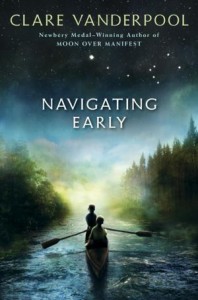
    The Plot (in 5 sentences or less):  The year is 1946 and 13 year old Jack Baker from Kansas is sent to the Morton Hall Academy for Boys in Maine after his mother dies and his father returns to the Navy.  At his new school, Jack feels like an outsider but soon meets Early Auden, an eccentric boy who has a genius for such things as mathematics and small boat craft and is also constructing an elaborate story around the number pi.  As their friendship develops, Jack learns that Early is also mourning his brother, who was reported dead in France in World War II.  Over fall break, the two boys push off into the Kennebec River and go on a mysterious journey that will bring them closer to their lost loved ones.

    My Take:  From the midpoint of the book until the end, Vanderpool injects a strong dose of magical realism, involving such things as pirates, anthropomorphic bears, and a volcano.  I was initially skeptical of these fantastical elements, but, towards the final chapters, I decided that the author had pulled it off.  I would consider this a very special book that explores the mysteries of grief.  There is a great deal of symbolism and meaning and Vanderpool draws heavily on fairy tale and archetypes to add depth to the narrative.  I found Navigating Early to be a profound exploration of how we search for answers in our bereavement.  (ages 12+)

    One Interesting Note About the Author:  Vanderpool researched Navigating Early by visiting Maine and exploring lighthouses, a boarding school, and even taking a hike on the Appalachian Trail.  She did not see any bears.


  • BMP_8823_JT.indd

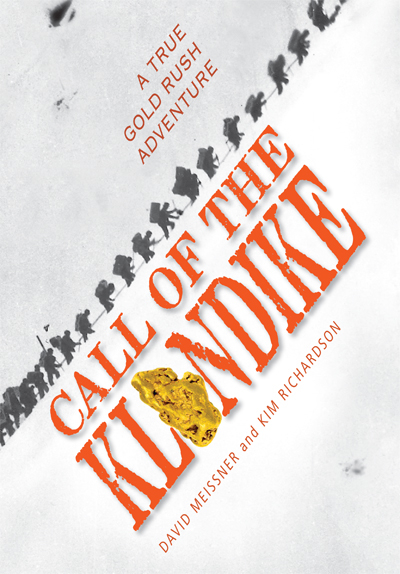
    The Plot (in 5 sentences or less):  This nonfiction book follows the journey of two young men, Marshall Bond and Stanley Pearce, as they journey into the Klondike during the gold rush.  Starting in the summer of 1897, they make the decision to head for British Columbia only a few hours after gold rumors began flying.  Sailing to Skaguay, Alaska by ship, the men put together an outfit and journey over the White Horse Trail, over several lakes, and into the waters of the Yukon River.  They arrive in Dawson City in the fall, build a cabin, make connections and begin doing the hard work of staking and working a mining claim.


    My Take:  I was impressed by the use of primary source material, the letters of Bond and Pierce, throughout the book.  Selected passages from the letters are interesting and understandable to modern younger readers.  The authors’ own writings that are interspersed between the letters adds a fuller picture of the arduous Klondike journey.  The generous amount of photographs and maps also add to the appeal.  I would absolutely recommend this book to younger readers interested in the gold rush of the late 1890’s.  Ages 12+


    One Interesting Note About the Author(s):  Kim Richardson is the great-great-grand nephew of Stanley Pearce.   In the summer of 2010, David Meissner retraced some of the journey of Bond and Pearce into the Klondike.  He stated that “every step of the trail made me appreciate the toughness of these stampeders.”


  • paperboy_vawter

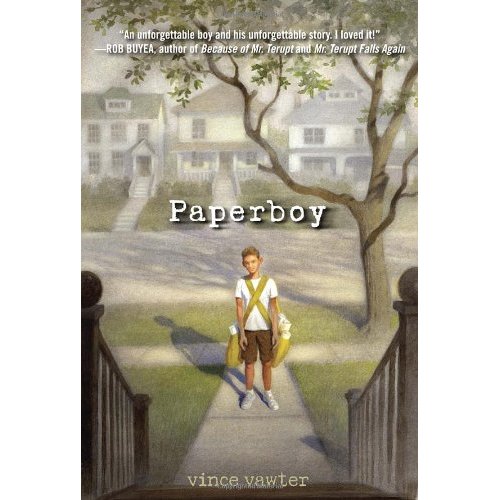
    The Plot (in 5 sentences or less):  Set in 1959 Memphis, Tennessee, an 11 year old takes over a friend’s paper route for a few weeks during the summer.  The young man suffers from  stuttering and it colors his entire life.  As he slowly makes his rounds, he becomes involved in the lives of his customers which opens up greater questions.  What should he do, for example, about the possible domestic abuse suffered by one lady or the riddles scribbled on a dollar bill given to him by one erudite man?  Events come to a violent head when his housekeeper confronts the local homeless man about some items stolen from the household.

    My Take:  Credit should be given to Mr. Vawter for using a protagonist with a speech impediment.  Any teen with a stuttering challenge should absolutely read this book.  The author does an excellent job of showing the reader what it is like to live daily with this problem.

        Vawter has a restrained writing style that allows him to slowly construct the characters and the plot.  Because of this, Paperboy may be too slowly plotted for some young readers.  Much of the book is committed to the narrator’s cautious approach to building relationships with adults in his life.  Still, towards the end of the book, I did get some goosebumps, that visceral test of any work of art.

    One Interesting Note About the Author: Vince Vawter’s first memory of his stutter is just before the age of 5.  Despite his stutter, he has had a rewarding career in newspapers.  As he tell it in the author’s note, “have I been cured of my stutter? No.  Have I overcome it?  Yes.”

  • father-groppi

    The Plot (in 5 sentences or less):  Father Groppi was a leader in the civil rights movement in the 1960’s in Wisconsin.  While he attended seminary as a young man, James Groppi worked in youth centers in underprivileged areas in segregated  Milwaukee where he learned about the travails of the African American population.  After becoming ordained, he traveled the south during the 1950’s and early 60’s where he witnessed first hand the violent racism of the south.  Deciding to bring the civil rights movement to Milwaukee, Father Groppi began organizing marches demanding treatment in equal housing and public education.  His most famous moments came when he marched a group of blacks over the Sixteenth Street Viaduct into the working class white enclaves.


    My Take:  This is a straightforward book that will not only introduce young readers to Father Groppi’s struggles in Milwaukee, but also to the broader struggle of civil rights. Throughout the book, the author defines and explains terms and concepts such as “boycotts” and “civil disobedience” that may seem unfamiliar to younger minds.  If you are looking for a biography on a lesser known civil rights advocate, this would be an excellent choice. ages 10+


    One Interesting Note About the Author:  Stuart Stotts is not only an author, but also a dynamic speaker, performer, and early childhood educator trainer!  Check out more about him at his website:  stuartstotts.com


  •  

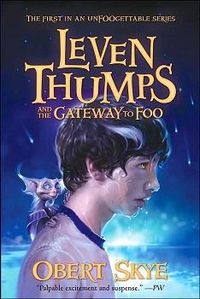
    Leven_Thumps_and_the_Gateway_to_Foo_coverThe Plot (in 5 sentences or less):  Leven Thumps is a 14 year old boy in Oklahoma whose life changes when he meets Clover, a small fantastical furry creature.  Through his time with Clover, Leven finds that he has the power to summon lightning and also to see into the future.  They soon meet a girl named Winter, who is blessed with the ability to change anything into ice, and Geth, a shape shifting being that was once a king.

    In time Clover and Geth reveal to them that their powers are to save a magical world named Foo which is being threatened by the evil Sabine.  The four set out to find the doorway to Foo before Sabine and his shadows can find and kill them.

    My Take:  This is a YA fantasy that gets the job done.  It is paced quickly enough to keep the plot going without sacrificing character development.  Fans of Harry Potter and of that ilk will appreciate the first in this 5 book series.  Ages 11+

    One Interesting Note About the Author:  According to his website, Obert Skye “currently lives indoors and near a thin, winding road.”  Now that IS interesting!


  • Bomb_sheinkin

    The Plot (in 5 sentences or less):  Tipped off by European physicists in 1939 that it was possible to create an extraordinarily dangerous bomb, FDR signs the order which sets off the race to create this powerful weapon before the Nazis do.   Brilliant physics professor Robert Oppenheimer puts together a team of world class talent and brings them to Los Alamos, New Mexico.  Meanwhile, Russian agents scramble to cultivate spy connections to penetrate the military base and steal the secrets behind the atomic bomb design.  Concerned that Nazis are ahead in the race to build the bomb, partisans attack a heavy water producing plant in Norway to to inhibit German efforts.   The final chapters of the book cover the story of the dropping of the two atomic bombs on Japan and the devastating effects.

    My Take:   I was lucky enough to hear Steve Sheinkin speak at the Virginia Library Association’s Conference in Williamsburg, VA on September 27 when he accepted an award for this book.  It is definitely well deserved.  Bomb is tightly written and reads like a fiction thriller.  I read it in probably two sittings and simply did not want it to end.  My one critique of the book is its use of conversational dialogue throughout.  I always question when historical non-fiction books use quotes: how do they know that they said exactly that?  Still, this is a mild criticism for a wonderful book.

    One Interesting Note About the Author:  Steve Sheinkin started his career by editing and writing textbooks.  Disenchanted with how many interesting stories that he had to leave out of the history books, he began writing history books for kids in which he could keep all of the fascinating odds and ends.


  • etched-in-clay-andrea-chengThe Story (in 5 sentences or less):  Dave is a slave purchased by Harvey Drake in Augusta, Georgia in 1815.  Harvey takes him to Pottersville, South Carolina and not only teaches him pottery, but also how to read.  Over the span of years, Dave suffers greatly as his loved ones (including two wives) are sold away.  Dave begins carving words and poems into some of his pottery, a small act of sedition and outlet for his grief.

    My Take:  I wondered if this book would be able to measure up to the quality of the Caldecott Honor book “Dave the Potter;” I believe that it does.  Written in short chapters of verse in 1st person, the poetry is never intrusive or self conscious, but rather breathes real life into the characters.  The poems are lean and spare, but sketch out the characters enough so that we grieve at the tragedies in Dave’s life.  I’d recommend this book to readers ages 11+ who are interested in knowing what being a slave feels like.  An appendix explains the life and times of Dave from an historical perspective.

    One Interesting Note about the Author:  Andrea Cheng’s interest in Civil Right’s issues began at an early age when, growing up in Cincinnati, she remembers “sitting in the front yard with [her] friends, most of whom were African American, and hearing the sounds of the 1968 race riots just a few blocks away.”

  • ballad-of-jesse-pearlThe Story (in 5 sentences or less):  Jessie Pearl is a 14 year old girl living in rural North Carolina in the early 1920’s.  Her mother died a few years before and Jessie, bright and academically minded, promised to her mother that she would go to “teacher’s school” and make something of her life.  Her plans are complicated however, when her older sister Carrie, having recently given birth to a son, dies of tuberculosis and Jessie is now in charge of the child.  This, coupled with her feelings for local farm boy J.T., are strong reasons that pull on her to stay put.  Will Jessie Pearl settle down early and become a mom and farmer’s wife, or will she head to the teacher’s school in the mountains of Watauga County?

    My Take:  I thought that this book was well written.  Hitchcock set out to write a story that brought to life her family’s trials in North Carolina on the eve of the Great Depression.  My own family haunted the mountains of the North Carolina-Tennessee border during this time, so that may have been one reason why I appreciated this book.  My one criticism is that I found myself wondering if the pace, while fine for an old man like me, was too slow for younger readers.  This may be a book that older readers, say 15 and above, can appreciate.   The theme and plot of this novel great reminded me of Katherine Paterson’s “Lyddie.”

    One Interesting Note About the Author:  According to her website, the death of her sister in a car accident in 1999 provided the motivation for her to begin writing novels.  She decided that “life was too short for unfulfilled dreams.”


  • coopermetaldetector Genre:  Juvenile Fiction

    Audience: Ages 10+

    Rating (out of 5): 2

    The Story (in 5 sentences or less) :  Cooper is a boy that lives with his mom on a farm in New York state where they run an antiquing business out of their barn.   But business is slow and money is tight ever since Cooper’s younger brother passed away and his dad left.  His life changes when he is given an enchanted metal detector that can talk.  Using this magic machine, he begins digging up musket balls in his yard and learns that his house is on the exact location of the Revolutionary War Battle of Newton.  Cooper must use his friendship with Mr. Shepard, the local historical museum director, to fight off government bids for their land.

    My Take:  Somewhere within this prolix, sometimes clumsy book is a much better book.  I applaud Osterweil’s premise of a young man delving into antiquing and amateur archaeology.  I appreciated the parts where Cooper was on the hunt, digging up artifacts in his back yard and matching them up to local history.  Less enjoyable for me were the mystical parts of the book in which he communes with his dead brother, the planet earth, spirit wind, etc.   I found that the anthropomorphic objects slowed the pace of the book and were sown awkwardly into the narrative.

    One Interesting Note About the Author:  According to his website, Adam Osterweil   “teaches junior high English at Springs School in Springs, New York. His hobbies include kayaking, historical research, and metal detecting.”

  • Genre: Historical Fiction

    Series? No

    Audience: ages 9+

    Rating (out of 5): 3

    The Story (in 5 sentences or less):  Growing up in his Uncle Diego’s house in 15th century Spain, Baltasar often heard stories of the famous Moorish warrior-sorcerer Amir Al-Katib.  Thinking them to be nothing but stories, Baltasar is deeply confused when he is picked up by the Malleus Maleficarum, an arm of the Inquisition devoted to hunting sorcerers, and interrogated as to the whereabouts of Al-Katib.  During his interrogation, he finds that he also possesses magical powers, capable of summoning creatures from ancient stories.  Searching for answers, Baltasar discover’s that he is in fact the son of Al-Katib and that he must journey west to fight an evil that “threatens to destroy the world.”  Baltasar procures a position on the Santa Maria, captained by Christobal Colun,  on which he will sail towards the west, across the ocean in search of his father and the answers to his past.  

     My Take:    This is a book, much like A Wrinkle In Time, of a character searching for their father.  I give high marks to Mlawski for creating a multi ethnic protagonist who is searching for answers to their heritage.  This theme seems apt as much today as it was back in 1492.  One criticism is that as the book progresses, as more and more characters are introduced, I felt like some of them were redundant.  Was it necessary to encounter two island tribes?  Could not the character of Catalina be completely stricken and make for a tighter book?  Consequently, the final third of the book feels heavily weighted to me, and there were moments where I had to slow down to keep everyone straight.  

    One interesting note about the author:  According to her website, Shana has read every Goosebumps and Baby-sitters Club book!  Quite a feat indeed!